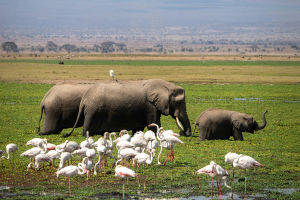
Standing near a watering hole in the savannah, you might notice an elderly elephant pausing as if recalling something long past.
Perhaps it is a familiar path, a distant relative, or the memory of a challenging season.
Observing this, one wonders: how do these gentle giants retain such vivid recollections for decades, navigating complex social and environmental landscapes with remarkable precision?
The Biological Basis of Memory
Elephants possess one of the largest brains among land mammals, with highly developed temporal lobes, which play a key role in memory formation. Researchers have discovered that the hippocampus, crucial for spatial and long-term memory in many animals, is especially large in elephants. This neurological structure supports not only remembering the location of water sources but also recognizing dozens of companions across years.
1. Spatial Memory
An elephant matriarch can recall seasonal watering holes and food sources even after years of absence. Such memory allows her herd to survive droughts, avoid dangerous terrain, and find sustenance over vast areas.
2. Social Memory
Elephants can identify hundreds of other elephants by sight, sound, and even smell. This ability ensures that long-lost relatives or herd members are recognized, maintaining social cohesion and facilitating cooperation.
3. Event Memory
Elephants also remember traumatic or significant events. For example, a herd may avoid areas where predators or human threats were encountered years before, demonstrating a form of experiential learning critical for survival.
Observations in the Wild
Field studies offer vivid examples of elephant memory in action. In Botswana, a herd led by an elderly matriarch navigated over 50 kilometers of dry terrain to reach a hidden waterhole known only to her. Similarly, elephants in African reserves have been observed recognizing former herd members after decades of separation, greeting them with vocalizations and physical gestures like touching trunks.
These observations highlight memory as a dynamic, practical tool rather than a mere cognitive quirk.
Implications for Conservation
Understanding elephant memory has profound conservation implications. Protecting older matriarchs is vital, as their knowledge guides entire herds. Without these key individuals, younger elephants may struggle to locate water, navigate migration routes, or maintain social bonds. Conservation strategies increasingly focus on preserving multi-generational herds, acknowledging that experience and memory are as crucial as physical protection.
1. Habitat Protection
Ensuring elephants have access to traditional migration routes and watering areas preserves the utility of their memory.
2. Social Preservation
Avoiding disruptions that separate older and younger elephants helps transmit essential knowledge across generations.
3. Human Interaction Awareness
Awareness of how elephants remember dangerous encounters can guide safer coexistence, preventing conflicts and promoting harmonious conservation efforts.
Memory Beyond Survival
Elephant memory also shapes their social and emotional lives. Mourning behaviors, play, and social support are often influenced by long-term recollections. Memories of companions who have passed or distant relatives drive nurturing and protective behaviors, demonstrating that memory is intertwined with both survival and emotional intelligence.
Observing elephants in their natural habitats reminds us that memory is more than a mental function—it is a bridge connecting past, present, and future. Their remarkable recall offers lessons for humans about the value of experience, continuity, and the quiet power of remembering. By protecting their habitats and social structures, we safeguard not just elephants' physical lives but the rich tapestry of memory that guides them through decades of challenges and triumphs.