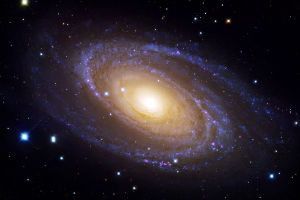
Have you ever wondered what lies beyond the stars we see at night? While our eyes can only perceive the universe through visible light, there is another hidden side of the cosmos that remains invisible to us.
This is where infrared astronomy comes in. It acts like a new sense for observing the universe—allowing us to look through clouds of cosmic dust, explore star-forming regions, and study distant structures in space.
In this article, we will explore what infrared astronomy is, how it works, and why it plays a crucial role in modern space science.
What Is Infrared Astronomy?
Infrared astronomy is the study of the universe using infrared radiation, a form of light that is invisible to the human eye but can be detected as heat. Its wavelength lies between visible light and microwaves in the electromagnetic spectrum.
Unlike visible light, infrared radiation can pass through dense clouds of gas and dust in space. This makes it possible to observe regions that would otherwise remain hidden.
Through infrared observations, scientists can study the birth of stars, the formation of planetary systems, and the structure of distant galaxies across cosmic time.
How Infrared Observations Work
Infrared astronomy relies on highly sensitive detectors designed to capture faint heat signals from space. These instruments convert infrared radiation into digital data, which is then processed into images and scientific information.
Because Earth’s atmosphere absorbs much of the infrared radiation, the clearest observations are made using space-based instruments and high-altitude observatories.
These technologies allow scientists to:
- Observe stars forming inside dense molecular clouds
- Detect cool celestial objects that do not emit visible light
- Study distant galaxies in their early stages of formation
Exploring the Universe Through Infrared Light
Infrared astronomy reveals aspects of the universe that cannot be seen with visible light alone.
1. Distant galaxies:
Infrared light can travel through cosmic dust, allowing scientists to observe galaxies that formed billions of years ago and study how they evolved over time.
2. Star and planet formation:
Infrared observations reveal regions where gas and dust collapse to form new stars and planetary systems. These processes are often hidden in visible light.
3. Cold and hidden objects:
Many celestial objects emit very little visible light due to low temperatures. Infrared technology makes it possible to detect and study these faint objects in detail.
Challenges and Advancements
Infrared astronomy faces several challenges. Infrared detectors require extremely sensitive technology, and many signals are absorbed by Earth’s atmosphere, limiting ground-based observations.
Despite these challenges, advancements in space technology and imaging systems have significantly improved observation quality. Modern instruments now provide clearer, deeper views of the universe than ever before.
These improvements continue to expand our understanding of space, allowing more detailed studies of distant galaxies, star-forming regions, and planetary environments.
The Future of Infrared Astronomy
Infrared astronomy continues to be a key tool in exploring the universe. As technology advances, scientists are able to observe deeper into space and further back in time.
This field helps reveal the history of the universe—from the formation of the first stars to the development of complex galaxies.
With continued innovation, infrared astronomy will further enhance our understanding of cosmic evolution and the structure of the universe.
Infrared astronomy provides a powerful way to explore the universe beyond what the human eye can see. It reveals hidden structures, uncovers the process of star formation, and expands our understanding of cosmic history.
Although much of the universe remains invisible in visible light, infrared technology allows us to uncover these hidden layers.
The universe is far more complex and fascinating than it appears—and infrared astronomy helps us see it more clearly.