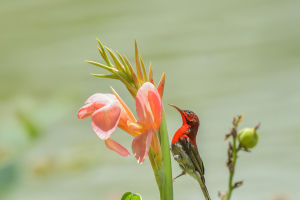
Hello, Friends! Among the many colorful birds found across tropical Asia, few capture attention as effortlessly as the crimson sunbird. Its brilliant scarlet feathers, accented by shimmering metallic hues, create a dazzling display as it moves from flower to flower.
Small but energetic, the crimson sunbird is a vital pollinator whose specialized beak, agile flight, and vibrant plumage make it one of nature's most fascinating avian jewels.
Native to Southeast Asia, the crimson sunbird is commonly found in countries such as Thailand, Malaysia, Singapore, Indonesia, Brunei, and the Philippines. Although many people admire its beauty, there is much more to this energetic bird than its striking appearance. Here are five fascinating facts that reveal why the crimson sunbird is one of the region's most remarkable nectar feeders.
1. Males Display Brilliant Colors While Females Blend Into Nature
The crimson sunbird is a striking example of the distinct differences in appearance between males and females. Males are famous for their vivid crimson head, chest, and back, complemented by metallic green patches on the wings and shoulders. Depending on the angle of sunlight, these glossy feathers can shimmer with shades of emerald, bronze, or deep violet, creating an almost jewel-like appearance.
Females, however, wear olive-green upperparts with pale yellow underparts. This more subdued coloration provides excellent camouflage while incubating eggs and caring for nestlings, reducing the risk of attracting predators. This difference in appearance allows males to advertise their health during courtship while helping females remain hidden during the breeding season.
2. Their Curved Bills Are Perfectly Designed for Feeding
One of the crimson sunbird's most distinctive features is its long, slender, downward-curving bill. This specialized shape allows the bird to reach nectar hidden deep inside tubular flowers that many other birds cannot access. Using an equally long tongue tipped with tiny brush-like structures, the bird rapidly collects nectar while minimizing energy expenditure.
Although nectar supplies much of its daily energy, the crimson sunbird is far from being a strict nectar specialist. It regularly feeds on spiders, ants, caterpillars, beetles, and other small insects. These protein-rich foods become especially important during the breeding season when rapidly growing chicks require balanced nutrition for healthy feather and muscle development.
This flexible diet enables the species to thrive even when flowering plants become temporarily scarce.
5 Surprising Facts About Crimson Sunbird You Never Knew!
Doğa Ve Kafes Kuşları
3. Crimson Sunbirds Are Important Pollinators
Every feeding visit benefits not only the bird but also the plants it depends on. As the crimson sunbird inserts its bill into flowers, pollen sticks to its forehead, throat, and bill. When the bird flies to another blossom of the same species, some of that pollen is transferred, allowing fertilization to occur.
Many tropical flowering plants have evolved alongside nectar-feeding birds like the crimson sunbird, developing flower shapes that closely match the bird's curved bill. This long-term evolutionary partnership helps maintain healthy populations of native trees, shrubs, and vines throughout tropical ecosystems.
By supporting successful plant reproduction, crimson sunbirds indirectly contribute to food and shelter for countless other wildlife species.
4. Their Hanging Nests Are Ingenious Structures
The crimson sunbird builds one of the most distinctive nests among small tropical birds. Rather than constructing an open cup, the female weaves a hanging pouch suspended from thin branches, vines, or ornamental plants. The nest is built from fine grasses, root fibers, leaves, seed fluff, and strands of spider silk, which act as a natural adhesive while allowing the structure to remain flexible.
Small pieces of bark, lichens, and dried leaves are attached to the outside, helping the nest blend naturally into surrounding vegetation. A small side entrance provides access while protecting eggs and chicks from heavy rain and many predators. Once completed, the nest forms a lightweight yet durable shelter capable of supporting both the incubating female and her developing young.
5. They Adapt Surprisingly Well to Human Environments
Unlike many tropical birds that depend exclusively on untouched forests, the crimson sunbird has demonstrated remarkable adaptability. It is frequently seen in botanical gardens, city parks, orchards, suburban neighborhoods, and home gardens wherever flowering plants are abundant.
Native and ornamental species such as hibiscus, heliconia, coral vine, and bottlebrush provide valuable nectar sources throughout the year.
Despite this adaptability, healthy populations still rely on diverse flowering vegetation and suitable nesting locations. Habitat destruction and the removal of native plants can reduce food availability, particularly during breeding seasons.
Creating bird-friendly gardens by planting a variety of nectar-producing native flowers helps support crimson sunbirds while also benefiting butterflies, bees, and many other important pollinators.
Why This Tiny Bird Matters
Although the crimson sunbird measures only about 4 to 5 inches (10 to 12 centimeters) in length, its ecological importance extends far beyond its size. As both a pollinator and an insect hunter, it contributes to healthy plant reproduction while helping regulate populations of small invertebrates.
Scientists also consider nectar-feeding birds valuable indicators of ecosystem health because changes in their populations often reflect shifts in flowering plant diversity and habitat quality. Protecting the environments that support crimson sunbirds also protects countless other species sharing the same tropical ecosystems.
The crimson sunbird is much more than a brilliantly colored bird decorating tropical gardens. Its dazzling plumage, specialized feeding adaptations, vital role in pollination, carefully crafted hanging nests, and remarkable ability to thrive alongside people make it one of Southeast Asia's most fascinating birds. Every visit to a flower represents an essential partnership that helps sustain entire ecosystems.